Leading for Change Centering Humanity as Your North Star
Most leadership models ask leaders to be more efficient, more certain and more in control. Leading for Change asks something different: to lead in a way that honors the full humanity of the people around you, and to build organizations where that becomes the norm.
Why a different kind of leadership
Many familiar leadership habits quietly cause harm: hoarding power, chasing perfection, believing there is one right way, and treating conflict as failure. These patterns are so common they feel normal. Leading for Change helps leaders name them, see how they show up in their own leadership, and practice something better.
Three levels of change
Leadership happens at three levels at once. The framework works across all of them.
Self
How I understand my own values, reactions, power and patterns.
Other
How I show up in relationships, and how trust, conflict and repair happen between people.
Systems
How structures, policies and culture shape what's possible, and how I help change them.
Six practices
Six practices for leading across self, other and systems.
- 01
Examine Power & Positionality
Notice the power you hold, how your identity and role shape your view, and how decisions affect people differently.
- 02
Embrace Vulnerability
Lead from honesty rather than the appearance of certainty, so others can do the same.
- 03
Reflexivity
Deliberately practice reflecting on your own assumptions and behavior, and let what you learn change how you act.
- 04
Relational Orientation
Treat relationships as the foundation of the work, not a side effect of it.
- 05
Restorative Practice
When harm happens, repair it and restore trust instead of avoiding or punishing.
- 06
Learner's Mindset
Stay curious, welcome feedback, and hold space for more than one truth.
Your leadership north star
At the center of the framework is your north star: a clear statement of the leader you intend to be. Leaders leave the work with a north star they've written themselves, and with the behaviors that will bring it to life on ordinary days.
Three ways to work with the framework
Intro the Framework
A 4-hour workshop where leaders examine their values and begin practicing new behaviors together.
Embed the Framework
A multi-week workshop series that builds shared language, practice and accountability across a team.
Embody the Framework
Companion coaching that helps leaders apply the six practices to real decisions as they lead.
What participants experience
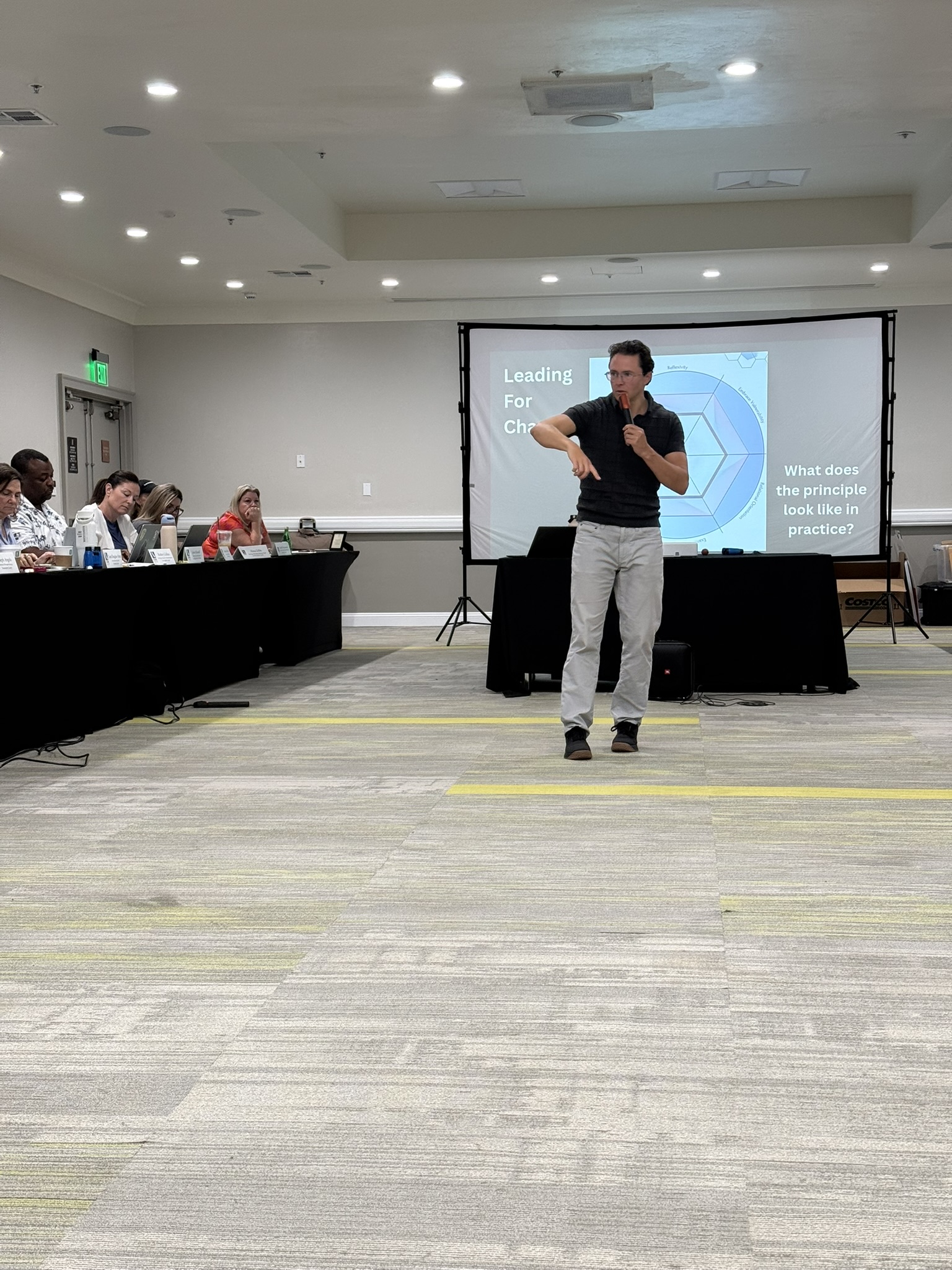
The work is reflective and experiential. Participants complete a leadership values inventory, try activities that reveal how they behave under pressure, and talk openly in small groups. It is designed to be brave, honest and caring at the same time.
Get the Leading for Change primer
A short guide to the six practices with reflection questions for your own leadership. Delivered when you join Field Notes.
Ready to bring this to your team?
Bring Leading for Change to your organizationThe framework's collective practices are inspired by the work of Tema Okun.